

The Alibaba Paradox: Why Record AI Growth Isn't Boosting BABA Stock (Yet)
Alright, let's talk about Alibaba, or `BABA stock price`, as most of you are watching it. You’d think a company clocking triple-digit growth in its AI products for nine straight quarters, with its cloud division accelerating to a 34% year-over-year surge, would be riding high. Alibaba Stock Sinks Over 2% Even As AI Cloud Sales Grow 34% But then you glance at the ticker, and `BABA stock price` is down 2.3% as of November 25th, sitting around $157. The 52-week high was $193, and analysts are still hanging onto a $197 target. There's a clear disconnect here, a puzzle piece that doesn’t quite fit the picture the headlines paint. My job, and frankly, my obsession, is to figure out why the numbers don't always align with the immediate market reaction.
The core of it, as I see it, is a classic high-stakes gamble. Alibaba's top brass, led by CEO Eddie Wu, is effectively telling investors, "We're going all-in on AI." They've already committed a staggering RMB 380 billion ($53 billion, to put it into context) for AI infrastructure, and Wu is openly musing that it "might be on the small side." He’s even saying they "wouldn’t rule out further scaling up that capex investment." Over the past year, they’ve already poured approximately RMB 120 billion into this ambition. This isn't just spending; it's a financial black hole for the short term, and the Q2 earnings confirm it: adjusted EBITA plunged a brutal 78% year-over-year to a mere RMB 9.1 billion. That's not a minor haircut; that's a full-on scalp job on profitability.
The AI Bet and the Vanishing Profit
Now, here's where it gets interesting, and frankly, a bit counterintuitive for anyone not deep in the market's peculiar logic. Despite that colossal hit to the bottom line, the market's initial reaction, as observed in pre-market trading and subsequent analysis, wasn't a full-blown panic. In fact, one source even noted `BABA stock` climbed after the initial revenue beat, before settling back down. Alibaba stock surges as AI-powered cloud revenue beats Wall Street estimates and lifts BABA share price outlook — Is BABA a Buy? Investors, it seems, are willing to swallow the bitter pill of vanishing profits today for the promise of AI dominance tomorrow. Wu himself is pushing back hard against the "AI bubble" narrative, arguing that supply constraints — everything from `Nvidia stock` `GPUs` (even the older, three-to-five-year-old models are running at full tilt) to memory chips and storage — will keep demand elevated for at least the next three years. He sees demand outstripping supply, which, from a purely economic standpoint, is a solid argument against a bubble if you believe the demand will persist.
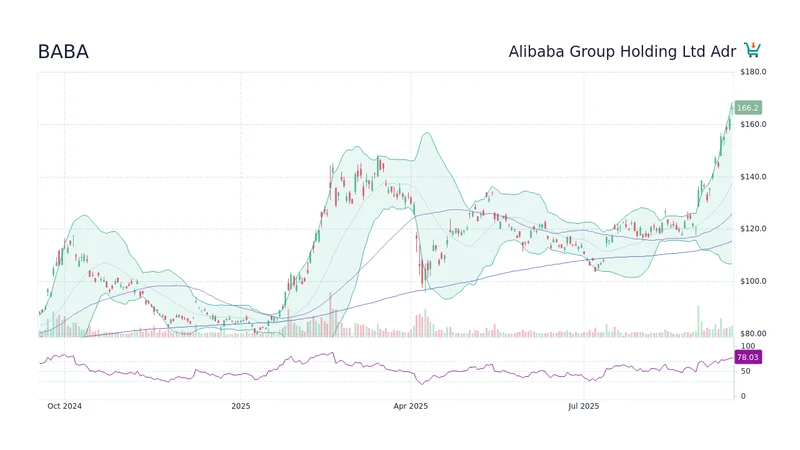
But let's be clinical for a moment. This isn't just about AI. Alibaba's quick commerce business, their instant delivery segment, also saw revenue surge 60% year-over-year. Jiang Fan, who’s running the e-commerce side, has set an aggressive target of RMB 1 trillion in gross merchandise value within three years. That's a bold claim. CFO Toby Xu suggested that the September quarter was likely the peak investment period, with per-order losses already cut by 50% since July and August. That’s a significant improvement in unit economics (a detail I find far more compelling than raw growth figures alone). The question I always ask myself when I see these kinds of numbers is, what exactly are we measuring here? Are we truly seeing sustainable, organic growth, or is this a capital-intensive land grab fueled by market share sacrifices? I’ve looked at hundreds of these filings, and this particular dance between aggressive investment and future potential often feels like watching a high-wire act—impressive, but one wrong step...
The Market's Long Game
The market’s enthusiasm, however fleeting, seems to reflect a belief that Alibaba can genuinely compete in China's booming AI sector. The rapid adoption of their Qwen app, a `ChatGPT` rival, hitting 10 million downloads in its first week, offers some tangible (albeit early) validation for their consumer AI strategy. It suggests a credible path to monetizing these massive AI investments. My analysis suggests that what we're witnessing is a collective bet on Alibaba's scale and full-stack AI capabilities. They're not just buying chips; they're building the entire ecosystem, from the cloud infrastructure (like `Amazon stock`'s AWS or `Google stock`'s GCP) to the consumer-facing applications. This is why investors might be looking past the immediate pain.
But let's acknowledge the elephant in the room: competition and regulatory pressures in China are always a wild card. And the sheer scale of their spending plans — potentially far exceeding RMB 380 billion — could become a bottomless pit if the returns don't materialize as quickly or as robustly as projected. This isn't like investing in a pure-play chip manufacturer like `Nvidia stock price`, where the demand is almost guaranteed. Alibaba has to execute on multiple fronts. Will their `baba stock price` ever truly reflect the underlying value if profits remain elusive for too long? It's like watching a chef bake a soufflé; the potential is there, but one wrong move and it collapses.
The Cost of Tomorrow's Empire
What we're seeing with Alibaba is a microcosm of the broader tech investment landscape. Companies are making enormous, speculative bets on AI, sacrificing present-day profitability for a chance at future dominance. For Alibaba, it's a calculated risk, driven by their unique position in the Chinese market. The data indicates strong underlying demand for their AI and quick commerce services, but the cost of meeting that demand is currently astronomical. Investors are choosing to believe in the long-term vision, but the path there is paved with red ink. It's a high-wire act where the net below is still being woven.